Firelight Bird Dogs

Firelight Bird Dogs

Friday, January 16, 2026

Toughness

By Lynn Dee Galey


Toughness. An underrated quality in a bird dog. Much of it comes from grit and drive. A lot of it comes from good feet and good, moderate conformation.  All of it is identified only through experience, over and over again. 


Toughness wasn’t really much on the board for me years ago when I was a New England grouse hunter. Hunts were shorter and on soft, moist forest floor. 


But moving to the plains and hunting there 70+ days a year reshaped my focus with my dogs. I watched which dogs had the stamina to hunt every day, harder and longer than others, yet avoid injury. Which dogs would use their teeth to rip Montana cactus balls from their feet vs the dogs who would stop and limp in for help. Which dogs could run on rough rocky ground without boots and which dogs would get footsore. 


I am blessed with wonderful owners for my dogs, many of whom push themselves and their dogs hard from Sept -January.  Dogs who push through the thick, tall, bone dry Kansas grass for pheasant. Dogs who run alongside the owner on mountain bike to hunt chukar slopes all day before biking back to camp. Dogs who learn about desert quail and the endless array of plants and footing there that can end a hunt. Dogs who plow through deep snow to point snow roosted ruffs for their snowshoed owner. Dogs who learn to slip beneath barb wire fences all day long with just a small withers scab.


Those owners and their dogs strongly influence my breeding decisions. Because for owners who passionately hunt many more days than the average hunter, yet have only one or two dogs, a dog who gets tired or injured easily would ruin their season. Hard to measure until truly tested, yet so important.  


Friday, December 5, 2025

Twice as Nice

by Lynn Dee Galey

The other day my friend Warren got one of those Facebook “Memories From This Day” messages with a photo. He sent it to me and we were instantly taken back to that day about a dozen years ago.


We quietly raised our guns to the ready position as we saw Tweed ahead pointing and relocating. She carefully slipped over the hill ahead of us in the field and out of sight. “Be ready, I warned, this spot looks like prairie chickens.” As we crested the hill a flock of 6-8 chickens flushed ahead of the dogs and us, just out of range, with the puppy in hot pursuit. The prairie teaches gunners about stragglers and sure enough, 30 steps closer 2 birds flushed and swung in front of Warren who was off to my left. Calmly, probably way too much so for his first time ever even seeing prairie chickens, each trigger was pulled and each dropped a bird. Woohoo!  

We agreed that both birds had dropped dead and Warren’s senior dog, Boone, was already on his way to retrieve the one that had fallen further out. Warren said he was going to go find where his puppy had disappeared to if I would handle the retrieves. First bird now in hand I saw that both dogs were now searching the closer spot where we had seen the second bird drop. Both were strong retrievers, no worries.

But when Warren returned with his grinning, panting puppy we still had not found the other bird. It had been one of those shots where the bird drops like a stone, not far off and well marked yet we could not find it. Fanning out in widening circles we and the dogs searched for well over half an hour. Losing a bird is always dismaying but to lose a prairie chicken taken on a double the first time someone has hunted them felt downright tragic.  

The afternoon was getting late and with a long walk back to the truck ahead of us we finally admitted defeat, barely able to enjoy the single chicken in Warren’s bag. We decided to cut a straight line back across fields, not even hunting our way back. We crossed two barb wire fences and fields and half way across the next 100+ acre field I realized that I didn’t know where Tweed was. Looking around I saw my orange girl far up in the field, working away from us. We watched for a minute and I’ll be darned; we saw her pounce and pick something up. A minute later she handed me Warren’s second prairie chicken, still very much alive.
 Prairie chickens are wily birds and that bird had run hundreds of yards from where it dropped but Tweed had picked up a thread of scent and pursued until success.

Needless to say our spirits were raised, Tweed was praised and we stopped to take this photo.


Saturday, September 20, 2025

That Important First Year

 by Lynn Dee Galey

Blending my profession and my lifetime with birddogs, I believe that puppies are like children regarding the plasticity of the brain, skill development, and social skills. For example, studies show that in children, learning skills such as language and music before the age of 5 results in a higher level of proficiency later.  For a birddog puppy, the first 12 months are the window of opportunity of their lifetime and lay the foundation for what’s to come.

Get your puppy into the woods or out onto the prairie and spend as much time out there as possible. Backyard obedience or trots around the neighborhood are important for all puppies but the classroom for a birddog is in bird habitat. Don’t limit it to hunting season;  learning happens year-round, every time they are out. At 2-4 months they are still small and running on trails is fine but by 5-6 months they should be starting to get into brush and explore.


These early adventures are also when you and pup expand your relationship into a hunting partnership. It is part of my dog’s job to keep track of where I am just like keeping track of them is part of mine. Teamwork to me is quiet.  It means the dog reads your body language so that even as they range out they notice you turning to look at a patch of cover and they swing into it without a word spoken. When you call the dog in to take a water break for both of you, they should learn it means hang here with me and relax for a bit.

Puppies are sponges and soak up the lessons learned in actual habitat. Smells, textures, sounds, wind, and variety in vegetation are recorded on the blank slate so that they become background and won’t interfere with the later more specific experiences of locating and handling bird scent.  


Bird contacts are the top layer of skill development. Skill in finding and handling birds is cumulative: every bird smelled, seen, and heard teaches a lesson. We want pup to contact as many wild birds as possible to begin to build the knowledge base. I have found that this bird contact piece between 6-10 months of age cannot be overlooked for a dog to reach its potential. It takes commitment on the part of the owner to provide the opportunities but is a piece of the puzzle that is a must.


Wild bird contact is where instinct interfaces with experience and pup begins to show us what they’ve got. In the long term, the ability to read cover, use the wind, nose power and the intelligence to apply it all to find birds does the sorting out of which dogs are good, best or just happy to be along.


The first 12 months pass quickly.  Don't miss out.


Wednesday, July 2, 2025

The Orvis Fly Rod

By Lynn Dee Galey

I’m not sure why I’m writing this here because it is off-topic from the Setters. It is a story about my Dad who was passionate about hunting and fishing. And it was my Dad who handed me a small collar for my 11th birthday and said the pick of the litter we had out of his Maggie was mine to keep for my first setter of my own.  So maybe this does fit here after all. 


My Fathers most treasured gift when he retired was a sweet little fly rod and reel from Orvis. He was a family man and would not have indulged in pricey gear for himself.  His more pedestrian rods and reels had always served him just fine.  But this little beauty was ideal for the streams and rivers in his beloved northwestern corner of Pennsylvania.  He put that rod and his retirement time to good use with countless little trips, yet always back home for lunch. 

The fish were not large but he didn’t care.  He practiced catch and release anyway. The challenge of convincing a trout to come out from beneath an overhanging bank and take his fly was enough. His time was long before artsy photos were taken to share a fisherman’s catch. The memories were enough. When I visited we would drive around and he would show me his “spots.”  Often they were small little streams, barely wider than his rod was long, riffles and pools to be seen only by those who walked along, shaded by tall hemlocks and moss covered banks. 

It was those moss covered banks that brought about his phone call to me one particular morning. His voice was sad and resigned as he described how he had slipped down a bank the day before. He fell onto and snapped the rod just above the smooth cork grip. After grieving overnight he had called Orvis to inquire about repair. This was long before the company’s “no questions asked” warranty. The service person who fielded his call was kind and listened to the story of how he came to own the rod as well as what had happened: she understood the importance of this little whip of gear. Rose assured him that they would do their best to repair the rod and instructed him how to send it attention to her name so she could help it through the process. 

He sighed as he told me that he instructed her to call with an estimate of cost before repair because his sense was that the repair would cost more than he could pay. As soon as we hung up I phoned the Orvis rod shop, which was only 4 doors down from my office in Manchester, VT, and I asked for Rose. Over the phone I sensed her smile as I said, "Here is my credit card number for the repair.  I don’t care how much it costs."

Less than two weeks later Dad excitedly told me that Rose had called saying the rod was repaired, “at no cost!”, and she gave him the FedEx tracking number as it had gone out that morning. 

But it never arrived. Despite multiple calls from Dad and Rose the rod was never found. Such sadness...until

about a month later when a different package arrived from Orvis. Inside was a brand new fly rod and a note from Rose saying that Orvis wanted him to get back to fishing. 

I inherited the rod too many years ago now. How I wish I could hand it and his net back to my Dad and send him off with one of my friends who guide nearby with their wooden AuSable longboats. They are good men and I know would make sure he didn’t slip on the banks. 


Saturday, June 14, 2025

5505

5505. That’s how many nights Storm has curled up on her blanket in her corner of my bed in her 15 years.  I don’t know what made me calculate that last night after she hopped up and settled in. 

I have had a setter sleeping at the foot of my bed since I was 11. I don’t want to know how many nights that is in total. Growing up, the family’s setters did not get onto the furniture yet my own dog did sleep on my bed. 

The spot on my bed had traditionally been reserved for the senior dog in my household. Yet Storm joined her mother, my beloved Tweed, when just a puppy. I don’t know why, some things I just don’t question.  When Tweed passed she left such a void that her other daughter, Sally, was invited to sleep on that corner of the bed. Sally’s passing last fall hit so hard that her spot remains empty in memory. Her granddaughter Dance slept there for a few nights last month when she was feeling lost after her puppies went to their homes. But she now contentedly sleeps next to her older daughter Crush on the sofa in the back living room. 

Several of the new puppy owners report that their young'uns are already sleeping in their bed with them, despite the best laid plans for them to sleep in a crate. Sometimes the circles of life are good dogs curled in a ball at the foot of the bed. 


Saturday, May 31, 2025

Pocket Tales: May 31. Empty Nest

Many ask how my dams react when their puppies leave to their homes. Dance has shown more attachment and concern than any other of my females.  She is such a good girl, perhaps tonight after the last pup flies off to Montana with her owner Dance will need to sleep in my room. 


Little girl sleeping alone for the first time. Curled up in the rocknbowl with her toy crown and dinosaur. 

Friday, May 30, 2025

Pocket Tales 5/30: Timing and down to 3

 An early morning trip to the vet showed that Pocket is still a couple of days from being ready to breed. Well, at least hormonally ready. Pocket is a force, aka Mob Boss, and last year intimated a stud so much that he refused to breed. I am trying a different stud this year in the hope that Pocket will like this boy better. Meanwhile I genuinely appreciate her hormones holding off until Dance’s pups have left so I will have the time to devote to driving Ms Boss to meet her suitor.

Six pups have left to their families with 4 going yesterday.  Reports back indicate everyone is doing well and having fun with owners actually getting some sleep. Just the 3 here this morning with 2 heading out this afternoon. Travel papers for border crossings and airlines are ready. Tonight, for one night, I will join the ranks of those with puppies adjusting to being without their littermates. Tomorrow it’s off to the airport to meet her family and she flies at their feet til home in Montana. 


Monday, May 26, 2025

Pocket Tales

We often forget that what is a way of life for us is quite unknown to others. It has been suggested that I journal about what it’s like for me having a pack of bird dogs and to plan and raise a litter. As I prepare to send my current litter off to their homes I am also juggling breeding Pocket for my next litter so this seems like a timely topic.  This is the first post, more over upcoming weeks.

I have only one or two litters a year, for many reasons. One huge reason for me is that I want a personal connection with the hunters I choose to get my puppies. Guys who are out there gunning over their dog 30-60+ days a year across the continent are the best way to get real-time feedback on the talent I’m producing. They are why I breed. With an average of 10 puppies in each litter, I simply would not be able to maintain good communication with more. 

I joke that I’m simply the social director for the puppies.  This morning is typical. A hunting buddy and his brother stopped in to visit; his brother had just missed out on a contract to buy his dream up-north house near here and consoled himself by sitting on the porch floor beneath a pile of puppies. As we chatted, a family who is getting one of these pups arrived. They had spent the holiday weekend up at their cabin and as such arrived in two vehicles full of kids and in-laws and joined us on the back porch. 

It’s now a couple hours later and quiet here once again as the others head back home. Dogs and puppies are sound asleep. Water bowls are cleaned and filled and it’s almost time for puppy lunch. I think I’ll do the same while I have the time. 

Puppies are good medicine


Monday, December 23, 2024

Gifts Wrapped in Belton Orange


"'There are two things got no place in this world," the Old Man said, "an old dog and an old man.  They perform no useful function, and generally smell bad, too.'"  -  Robert Ruark, The Old Man and the Boy (1957).

Christmas is nigh, and we've just come in from the cold, Seth, Casper, and I.  Like me, Seth needs more frequent comfort stops these days. Lately he summons me from his big orthopedic bed,  first with a series of low whines, then an indignant yammering bark, a stodgy English lord ringing for the butler who never gets to his master's chambers quickly enough.  Seth struggles to his feet while I put on my coat, his friend Casper, the terrorist terrier, dancing circles around us, taking up the conversation and reminding us that he needs to go out as well.

My great-grandfather's long strap of heavy sleigh bells hang inside the front door, our nod toward holiday decor.  They jingle all our way out to the cluttered porch where Seth gathers himself before easing down into the yard to make his rounds - truck tire, garden trellis, the perennial bush I planted last spring, the one with the name I can't ever remember.   Casper has already broken skim ice on the water bucket by the little garden cart. Seth joins him there for a long, loud drink.

I watch him there, tottery on an arthritic right stifle.  He blithely ignores the cranky little dog growling his objections to sharing the bucket.  I call them "Vincent" and "Julius" from the move Twins.  Like Julius, the Danny DeVito character, Casper is the product of the streets, a cagey, cocky stray adopted by my aunt out of a big city shelter. Seth is Arnold Schwarzenegger as "Vincent," the trusting, easy-going himbo who is forever wondering why our entire pack can't just get along.

The sun is out, but there's a chill wind blowing, and I'm grateful for the heavy fleece jacket.  If I don't chaperone, Seth will wander off, first to the pigeon loft to gaze up at birds loafing in their high aviary, then down into the barns just to see if there's a stray cat that needs pointing.  I remember a sporting photographer telling me that whenever a shot of a "hot point" is needed and there're no game birds handy, nothing makes a dog stand taller than a grouchy cat crouching in a wire cage.  The feral cats that ghost through our barns and loafing sheds won't hold, not even for a majestic, high-headed Seth point.  When they slip away,  the old dog shambles dejectedly back up to the house looking almost-but-not-quite-guilty.  Seth can't hear much, so he's apt to stand and wag his tail as I scold, "What are we doin' here?  Huh? Can you not just stick with the program of out-and-back-in?"
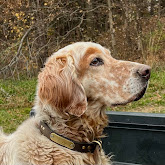

Today I am distracted putting some tools away.  When I look up, Seth is dog gone.  No faster than he walks these days, I know he's not far, and he's not - I find him trying to hoist himself up for a drink from the horses' water tank.  He acts surprised to see me and follows as I turn for the house.

Casper is barking at the door.  He is excited for his "We reported back like good dogs" treat from the big bag on the counter.  He is already bouncing there before Seth and I can jinglejangle back through the door.  An ear worm Christmas ditty twists into commentary on Seth's compromised gait:  "Sleigh bells ring/Are you listing?"  He gimps over to his own place near the treat bag, but lets Casper do the begging.  Seth always trusts that I'll hold up my end of any bargain;  Casper knows better.  Unlike Seth, he keeps score, recalling every time he's ever been shorted by my geriatric ADHD.


The dogs settle in as I drop back into my desk chair.  Holiday paper, scotch tape, and a pair of game shears, the only scissors I could find, are scattered on a low table by the desk.  The last several presents needing wrapped are stacked off to the side.  I check the football scores, go back into the kitchen to fetch the diet soda my doctor wants me to quit drinking, check messages to see if my friend Nick, hunting the last afternoon of our deer gun season, has a deer down and needs help.  This behavior is my version of Seth's wayward cat stalks: anything to keep from getting back to my fumble-fingered wrapping.  


 Seth's afternoon as baby sitter.

I hear Seth muttering as he works at getting comfortable on his bed.   We've both aged less than gracefully the past year.  For me, it was pneumonia that lingered for weeks, then a total shoulder replacement on the right side followed by five months of therapy.   For Seth, it's been the rise of arthritis in his right knee, the continued degradation of his hearing, as well as scattered incidents of what my vet calls "canine sundowner's," leaving him anxious and confused as the evening falls, sometimes through the night.  The big orange dog and I huddle together during those spells, our proof that we're brave for each other.  Always. 


In full retreat from Christmas chores now, I turn on the computer and pull up Seth's photo file. I browse scenes from Seth's time here with me and before with Lynn Dee.  The field portraits remind me that we're both retirees from Day Jobs we loved; I've never had a problem admitting that Seth was better at his than I ever was at mine.  


Strong, athletic, smart, sensible, the unfailing team player, Seth went to his game with an edgy confidence that pinned birds and made the shooter's role easy.  In his prime, he was fast and wide, confident and honest.  When he finished with an alder tangle or deep, aspen choked swale, we moved on.  Had there been a bird there, Seth would have been staunch downwind of it.

Woodcock hunting here in Ohio sometimes means punching into hells of saw briar, wild rose, and blackberry canes mean enough to test the toughest cordura field pants.  Seth would pile into those nasty patches, especially as he learned springtime woocock would rest in their shelter.  While I cringed, he'd bull through and come out the other end torn and bleeding, dog-smiling as if to say, "You, my man, know how to show a guy a good time!"  Never once when the cover was tough or the day extra long did he quit, hunting the whole way back to the truck every single time, even this season, literally on his last legs.

Did he ever get the bit in his teeth?  Sure.  But it was never with the self-hunting belligerence I've endured with other setters and pointers.  Seth was simply a determined dog with a lot of hunt, forever pushing cover.  He worked with a conviction that if the birds weren't Right Here, then they'd certainly be Right Over There, and he'd prove it to me if I would only swallow the whistle and stay out of his way.


From Seth's file, I click on one for the pointer Moxie, another for Fancy Dancer and Riley, still others for the good Aspenglow setters I followed for so long, photos from 42 years of pointing dogs. There are the recent pics of Firelights Deacon and Luke, and finally Lynn Dee Galey's Spice, Seth's granddaughter that Lynn Dee now lets me trail behind, all the while marveling at her bred-in gifts, smitten by her bright, quirky ways.  


It's the day after the Winter Solstice, and the night eases down like a slow curtain.  I turn off the computer and pretend not to see the family gifts yet to be wrapped.  Seth is stretched on his bed, breathing softly.  He doesn't hear me as I step into the kitchen, nor does he stir when the jingle door ushers Casper and me out for late chores.  We'll let sleeping Seths lie as we wrestle bags of dog food from the truck tailgate on to the porch and pour a bucket with kibble for the dogs who will eat outside. 

Their food bowls filled, Luke, Deacon, and the Labrador Finn don't even lift their heads at hoofbeats from fast stepping Amish harness horses clopping down our asphalt road, hastening buttoned up buggies full of my good neighbors to Sunday vespers.  Their church hall is north of the farm, and through the bare trees on my property line, I can see the glow of electric lanterns as men unhitch horses and lead them into the big barn parishioners built in a single day a couple of summers ago.  

Seth is standing at the door when Casper and I have finished, and of course, the first thing he wants is out.  I walk with him in the crisp December air, Venus already climbing the southwest sky.  I can't deny the small ache inside as the big dog dodders around the yard.  It seems like just the day before yesterday, he'd be an orange streak racing out into the hayfield to do his business, reluctantly trotting back up to the porch when I whistled.  


Presents With Presence:  Littermates Firelight Seth and the great Firelight Sally, Deacon's dam.

The season has me especially aware that every day with Seth has been a gift that I didn't deserve, full of the same kind of color and wonder and belonging that is the best of how my family and friends celebrate Christmas and Hanukka.  I like to think that every day Seth and I are together, we prove Robert Ruark wrong...at least the "function" part.  Our "function" is not letting how we are physically this evening make us forget how we've been so many other days and nights, hunting hard and living well.  My role is to remind him that everything's going to be alright.  His is to model being brave.

Always.


Wednesday, November 27, 2024

The Good Way

By Lynn Dee Galey

Today a texted photo and story made me give thanks before the calendar called for it on turkey day tomorrow.  

“Pup made a teenage boy very happy today. Young man’s first grouse over a point. It was as close to perfect as it gets and it’s an absolutely huge male. One of the biggest I’ve ever seen. Pup also made his owner very proud. I have always said one of the hardest birds to kill is a mature, male ruffed grouse. He was a rock star today, I can’t thank you enough for him!”

The young man is his daughter’s boyfriend and over two years had earned the invitation. Their day was a good one with my friend taking two grouse of his own.  I asked if the young man had taken a photo of him with his birds and his reply, “No. That’s ok. I have the memory and sometimes that’s enough.”

His modest reply is what being a hunter, a sportsman, a mentor, is all about. I’m proud to call him friend and thankful for the reminder of how good bird dogs impact our lives.


Sunday, November 24, 2024

Take the Photo

by Lynn Dee Galey


On the heels of my last blog post about social media saturation, at first glance the suggestion to take more photos may seem hypocritical. But I want you to take more photos for you. For your memories, for the years to come.


It saddens me that I have almost no hunting photos of the many dogs I ran before the digital photo era. I have been blessed to own some very special dogs and they shine in my memories. I would so love though to be able to look through photos of hunts with them or to share them with friends who never got to meet those dogs. 


Before digital, carrying a camera was not common and no one with whom I bird hunted ever did so. On rare occasion there might have been a tailgate shot with birds taken that day but even that would have been unusual. When I bought and started to carry my first digital camera – a 1.3 mp pocket camera – I remember mixed responses from others ranging from annoyance to intrigue.


I now encourage puppy buyers to use a camera as a training tool. When the dog goes on point, pausing to take a photo prevents the common training/handling error of rushing in to the point. It trains the gunner to not rush and reinforces that the dog must hold point until the gunner arrives and flushes.


Of course, when hunting many situations don’t allow for that pause, especially hunting ruffed grouse. But woodcock hold well. On prairie birds it is a must that the dog be staunch until the gunner walks the distance to reach them so the 30 seconds to take the phone/camera from a pocket, snap a pic from a distance, and put it back in is often very doable.

You do not have to take a photo of every point, but try for an action photo of every hunt. Don't worry if it isn't "magazine worthy", this is for you. Include the scenery and the habitat, as enjoying the wild is such an important part of why we hunt. Tailgate shots are ok but pics of your dog on point with the mountains or October’s foliage behind them bring the hunt back to life. The many times that you look back at those photos you will be glad that you did. 


Monday, October 28, 2024

Saturation?

By Lynn Dee Galey

Several folks have commented to me that I have not been posting as many hunting photos as usual and wondered why. After all, I used to take many photos on my almost daily hunts and often shared them.  I have had to think about what has changed for me and the best explanation I can come up with is social media.  

Pages and stories are filled with more bird hunting photos than ever. Traveling scenic shots. Tailgate shots. Artsy dog/gun/bird shots. Bird camp shots. Breeders doing marketing, thinly disguised as pic sharing. Empty hull collections. Tired dogs. Most are nicely done and most are done simply to share what likely was a rewarding experience.  

But I think for me personally it has just gotten to be too much. Saturation is perhaps the most fitting term. It’s entirely possible that it’s just me who is feeling this way. And I don’t know, I may change. But for now, I will continue to very much enjoy photos from friends and Firelight owners but am backing off from much of the social media noise. 

But know that the dogs and I are still out there in the beauty of October, celebrating days of good dog work and mistakes, plentiful birds and barren streaks, frosty mornings and sweaty afternoons. But I am staying more in the moment and soaking in the experience more than trying to capture it with a photo. 

My feelings on this could change and if it does, you will be the first to know through my posting of pics.  But meanwhile, know that the dogs and I are still out here simply enjoying the life. 


Saturday, August 31, 2024

A Glimpse of Fall

Temps on some recent nights have dipped into the 40’s, a few young trees are showing color and a few ferns are turning brown. Messages and conversations are asking what are my western travel plans, all indications that autumn is almost here.


Those who have met up with me on the road are familiar with this rig that served me well for many years.


But this year I switched up to something more compact and easier to manage, especially when traveling alone. The Class B+ motorhome itself is very nice for short trips for visiting and for hunting trips out west it will pull my Jeep to use for hunts. For those doing a doggy and crate head count and notice only 6 crates, my two senior girls will ride loose. 


An advantage of taking the whole pack with me is that my timing for travel is completely flexible.   Meanwhile I of course will enjoy the grouse hunting that surrounds my home but I will watch for favorable weather out west and head out when it feels right. 

This will be the second season for the young dogs from the trial-line outcross that I did last year, and I particularly can’t wait for them to get out west.  I have been able to closely watch the development of several from the litter, including the two that I own/co-own. There is less variation within the litter than often seen in outcrosses, which as a breeder is nice to see, and prelim X-rays were good/excellent. All did well in their puppy season with two stars who particularly embody the traits for which I was striving:  sweet, kind dogs who are easy to look at, live and hunt with.  At five months and for the rest of their puppy season, those two were slamming points on grouse with tall, proud points, backing, and retrieving. With their strong drive and bird finding, they have the raw goods, and I look forward to seeing how they continue to develop.  


I am impressed enough with that litter that this winter I am planning to do a similar outcross with their mother, my Dance, with a different, similar pedigree male that I met this summer.  Pictured below, he impressed me in many ways, and I am conversing with his owner about the possibility. Assuming these outcrosses prove themselves as I’m thinking, the next step in a couple of years would be to breed the offspring back into my own line to hopefully lock in the traits gained as well as preserve the long valued Firelight traits.  


So that’s a glimpse of what is planned for Firelight this fall.  I wish everyone a joyful autumn, doing what you love and hopefully following a white tailed setter afield. 

Cheers,
Lynn Dee


Sunday, March 10, 2024

Guyz Got Game

By Randy Lawrence

Painful admission:  I have been a sexist pig for most of my gun dog life.  I have traditionally owned, hunted, lived with (for) female English setters.

But when I hear bloviating self-appointed experts drone on about females being “more predacious” or males being “more focused in training” or females being "sweeter" or more "cooperative" or males being forever marking things and spoiling for a brawl, I'm the first to call "Meadow Muffins."  Most of those sorts of notions stem from folktales, casual-at-best dog handlers, and weird anthropomorphic stereotypes.  I simply liked a good dog;  several of my best just happened to be females.

Still, I get it.  Unlike other loathsome stereotypes, there are admitted biological considerations in bird dog girl/boy biases, especially with intact females who will absolutely come into heat on their schedule, not on the Division of Wildlife’s calendar of seasons.  And yes, males require monitoring and managing regarding manners and jostling for pecking order (though anyone who has broken up a fight between females, four-legged or two, might agree that breaking up a male fracas is much less perilous).

But in general, I believe issues of “maleness” in bird dogs are really handler issues.  In a short online piece entitled "Dog or Bitch - What Makes the Best Gundog," the trainer of Great Britain's Fenway Labradors, Jeremy Hunt, writes "(A) well-trained dog is aware that he has to contain his amorous intentions in just the same way that he has had to master other parts of his training as a civilized male.  For some owners that degree of control is not always achieved in their dogs and can be a lifetime nuisance."


In other words, most, if not all, of that Billy Bad Boy marking and humping and macho posturing is a handler problem, not a "comes with the testicles" inevitability.


I am almost embarrassed to admit that there was a time when my bias toward females was rooted in that I saw a great working female setter or pointer as a sustainable enterprise, one that would keep friends and me in class gun dogs into perpetuity, whilst generating a little sump'n-sump'n for the coffers.  Ask any serious gun dog aficionado who's at least on his or her 2nd kennel-and-yard scoop about that, and you will hear hearty guffaws (or at least discreet chuckles).  


For most of us amateurs deluded enough to raise two or three litters in a lifetime, that notion of reproducing Her Nibs of Wingbeats or, worse, generating a windfall of shekels-for-puppies seldom works out.  When it does, it's more serendipity than science.  And once we've outfitted friends, family, and ourselves with that next generation puppy, where's the backyard breeder's market for responsible, well-suited hunting homes?


We live and learn.   While we’re at it, let's dispense with the 300-lb gorilla in the corner:  the vets and quick-fix (pun gleefully intended) problem solvers whose answer to every behavioral issue even tangentially relative to our dogs' sexuality is drugs and scalpel.  That's the subject for its own blog post, but briefly, especially where males are concerned, my own observations come down solidly with the aforementioned Jeremy Hunt at scribehound.com : "...(W)hile vets are now very keen to dismantle male dog parts with great enthusiasm from a young age, the only real advantage I see is that it removes the ability to deliver the goods rather than diffuses (sic) the sexual urge.  So while it's never wise to make generalizations, I would say that castration does not always take away the sex-drive and is no auto cure to re-educating a dog that loves to go a 'bitching.'"


From the distaff side of things, spaying can have obvious and legitimate advantages for a working female, though not without certain concerns.  Likewise hormonal alteration or behavioral drug administration for either sex makes me more than a little concerned about long term consequences and possible impact on field performance.


So, all things considered, at this point in my life, when I look at a litter, it’s the male puppies I am watching. Sometimes, that’s an advantage in that we are living in a time which, for better or worse, has folks bent on a female, meaning there are often more males available from which to choose.


Beyond that, when folks ask, “Why a male?”, I nod toward the three male English setters and British Labrador who travel, hunt, and live day to day with me and each other with minimal supervision. Better yet, I hold up the example of my friend Flint, the intact Token Dude who amiably lives in a sea of progesterone at the Firelight home office.


Flint is a bird hunter's bird dog.  He trained early and naturally.  He hunts to the gun with great application and stands his game with intensity.  Around the vehicles between hunts and at the hearth at home, Flint is biddable, agreeable, and kindly.  Bonded for life to his littermate, Kate, you can usually find him taking his leisure alongside her on one of the dog-dedicated divans scattered around the places where Lynn Dee Galey's pack vie to be wherever she is.


Lynn Dee is not anybody's notion of a "common" dog handler.  Flint hit the ground with Firelight brains and temperament, but Lynn Dee schooled "Uncle," Firelight Seth and Flint the same way as she does the females:  gender is a fact, not an excuse.  There will be order in the House of Firelight, regardless of personal plumbing.


The frat house that is this old farm has hummed right along without fevered longing, misplaced marking, or dopey male posturing (at least from the dogs).  But a few months back, we were graced by a self assured, rough and tumble young female named Firelight Spice, a prospect of uncommon precocity (if I do say so myself).  Obviously, I am much smitten, as in the old days.  But as this brash, dark beauty finds her spot in our hunting and home rotation, Seth, Deacon, Luke, and Finn mind their gentlemanly etiquette and daily remind Spice and me that "guyz got game" too.