Firelight Bird Dogs

Firelight Bird Dogs

Sunday, July 3, 2022

Life As A Work of Art: An Osthaus Tale

by Randy Lawrence

When our bobwhite quail staged a mini-comeback in the mid 1990's, my friend Tom's family owned the most prosperous hometown bank in southeastern Ohio.  Tom's dad and grandfather had always had English setters, good ones.  They'd even done some horseback field trialing up on the Kildeer Plains back in the day.  

All that was before the great blizzards ravaged Ohio's bobwhite quail and pheasants.  Tom's people, being hard-bitten, bottom line guys, thought coal country grouse hunting was far too much hard hiking for not nearly enough shooting.  The setters got old, pacing in their posh runs.  When the last of those dogs died, the kennels stayed empty. 

But Tom's family still moved in gun dog circles, including the fellow who owned the hardware store. He had campaigned one great dog to two National Bird Dog Championships in the late '80's.  At breakfast  in the town diner, he had backed the local scuttlebutt about there being a few quail around.  That's when Tom gave me a call.

His dad's birthday was approaching.  For the occasion, Tom had lined up permission with several local farmers and wondered if my dogs and I would be willing to join them for the Saturday morning hunt his dad thought they "might could" spare from making money.    

 I remember the one covey find.  It was on the second farm we hunted, a delicious rolling tangle of overgrown pasture, one small woodlot, and a swath of scraggly field corn that had yet to be picked.  Tom's dad had laid out our line of march, and we swung into the light November breeze.

The day had long gone off the rails.  At the tailgate before the first hunt, Tom's dad learned that my dogs lived with me in my home, sparking a lecture on soft house dogs who "can't smell their own butt."  In the field, I spent most of the morning staring down the careless gun barrels of both companions.  That's why when Riley finally went solid and setter Dusk slid to a hot back, I stayed with the dogs, waving father and son on to flush.  

A good bevy of birds buzzed out of a multiflora rose spread, and there was a lot of shooting.  Tom emptied both barrels of his over under before the quail had barely cleared the brush, while his father pumped a svelte Model 42 like he was working it for a late mortgage payment.

Tom's dad thumbed more shells into the .410's magazine.  He said he had a line on some singles, but was convinced he'd dropped at least one bird. To his disgust, Riley and Dusk snuffled and scoured until they were just as convinced that he had not.  I sided with my dogs and urged them on.

Within minutes, a single got up in front of a Dusk point before I could hustle Tom into position.   We kept pushing, and Riley went missing.  I finally found the nearly all black pointer crouched into a "Right...THERE" pose on the edge of the woods.  

I waited for Tom's dad to step up wide to our left before I walked a fast arc to the right, trying to come back in toward the pointer's nose.  On about the sixth heartbeat, a brace of bobwhites clamored up and away through another pump gun fusillade.  

We circled back to the truck, where Tom gently checked his father from shoving his loaded shotgun into a soft case for the ride back to town.  By then, I'd had quite enough and politely tried to beg off lunch, but Tom said he’d ordered lunch brought in, and that we would eat up in the bank boardroom.  There was something there he and his dad wanted to show me.

"Tom tells me you're a gun guy," his dad said.  "You're gonna love this."

The room was upstairs, an opulent contrast to the spare, Mayberry-style bank setting - a beautifully appointed room centered with a gorgeous walnut table that matched dark wainscoting, all crafted from trees harvested on Tom's grandfather's farm.  What they had wanted to show me was the 1887 Colt lever action shotgun hanging on one wall, the barrel hacksawed short in its role as security weapon for the bank's early days.  Tom's dad was taking the gun down for a more personal show-and-tell when my eyes drifted to one of a dozen or so vintage bird dog prints lining the boardroom walls.

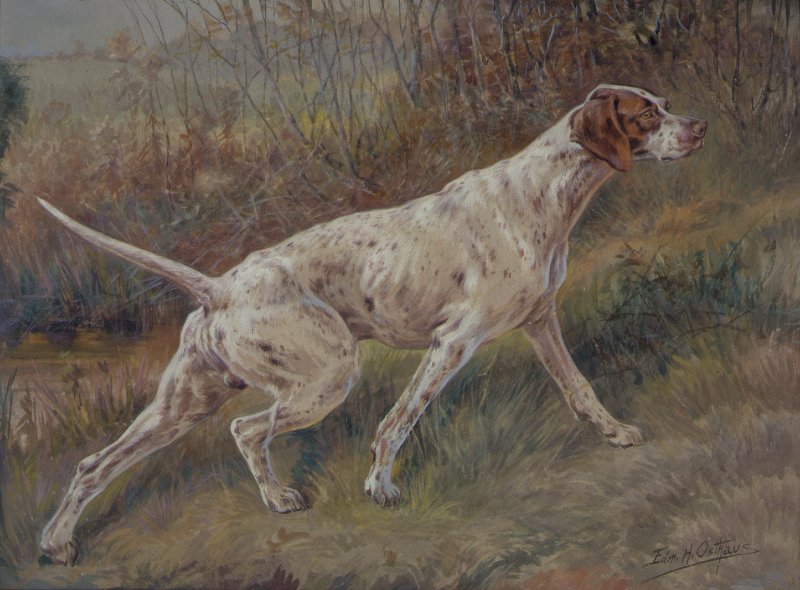
I had to step closer to be sure, but there it was.  A simply framed, original DuPont Gunpowder Company print of Lady's Count Gladstone from a painting by Edmund Henry Osthaus.  The National Field Trial Champion of 1900 is rocked back against scent coming in over her shoulder, the signature "Osthaus Tail" plumed at just above 45 degrees.


Hanging next to her was two-time National Champion Sioux.  Count Gladstone, winner of the inaugural national title, was down the way.  There was the print of Prince Whitestone and another of Joe Cumming, heirs to the great Llewellin invasion of the late 19th century.  The sole pointer portrait in the lot was of Manitoba Rap, the dog who broke the setter stranglehold on the Ames Plantation in 1909.  His haunches coiled like an African lion's, muscle and sinew rippling right off the print.


Sioux - National Champion 1901 and 1902

Count Gladstone IV - National Champion 1896 


Prince Whitestone -  National Champion 1907

I am not sure if the collection hanging upstairs in that backwater bank comprised a complete set of National Champions painted by Osthaus between 1896 and 1910.  Tom's dad knew little about what he called "the bird dog pictures," other than his own father had framed the DuPont ads over time and that they were "supposed to be worth something."  He had that old Colt repeater over his shoulder, following me as I made my way 'round the room, drinking in one beautiful piece after another.  When lunch was wheeled in, I reluctantly sat down to eat.

Joe Cumming - National Champion 1899

Manitoba Rap - National Champion 1909

I spent the next several weeks reading everything I could find on Edmund Henry Osthaus: German immigrant  - teacher, painter, field trial devotee, consummate gun dog man and bird hunter - whose art bankrolled his pursuit of sport, not to mention earned invitations to the finest wild bird shooting over the most acclaimed bird dogs the early 20th century had to offer.   His work hung in the salons of folks with names like Vanderbilt, J.P. Morgan, Pierre Lorillard, and of course, Hobart Ames who made his money in Boston and lived out his bird dog passions in Grand Junction, Tennessee.  

Osthaus was a charter member of the National Field Trial Association in 1896 and actually judged the National Championship stake in 1898.  For many years, he escaped Toledo, Ohio, winters for his own shooting grounds in Florida.

Edmund Henry Osthaus

One detail of Osthaus's life has haunted me ever since that forgettable quail hunt chanced into a most unforgettable art exhibit.  Osthaus had proudly served as Vice-President of the Continental Field Trial Club until 1917, donating a portrait of the group's annual champion as a coveted prize. But that year, as American doughboys marched off to the Kaiser's War, there was an ugly stateside backlash to all things German.  Edmund Osthaus, a naturalized United States citizen, was asked by club members to resign and leave the club.

In his 1990 book "George Bird Evans Introduces," the author shares bits from correspondence with the artist's son Franz.  Franz Osthaus writes that the cruelty of his father's ouster from the Continental Club marked "...a rugged period in our lives and it left an indelible impression on me."

But the man who had made his life a work of art quietly kept his faith.  According to Franz in a letter to George and Kay Evans, the older Osthaus spent his last years "enjoying an ideal arrangement, painting every morning and shooting quail every afternoon with dear friends and over the dogs he loved...I recall gathering after dinner at the shooting lodge fireplace, with the dogs toasting too, and the endless conversations about field trials, particular dogs and their performance, people, and places."

Franz remembers that his father "shot a Daly and a Remington, both twelve-gauge doubles, and he felt that two shots at a rising covey was definitely enough."

Oh, and one more thing.  "My father," Franz Osthaus writes, "refused to shoot with anyone who used a pump gun."


"Generations Have Used DuPont Powder" by Edmund Osthaus.  According to George Evans, the model for the boy in the print was Osthaus's son Franz.


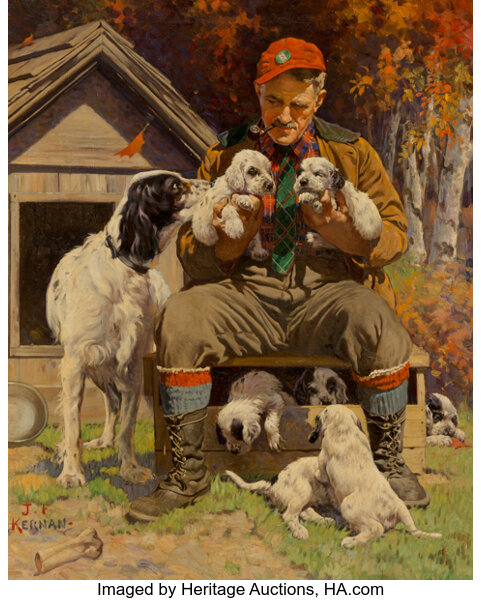
PS:  My current favorite Osthaus, one that I fancy, without provenance, to be a "self portrait," is the piece below.  It is a signed oil that sold at auction in May of 2021.  Osthaus would be horrified at the title assigned to the work by the gallery ("Hunter With Spaniels"), but the dancing setter and pointer, larking while the gunner lights his pipe, could not care less.   They are going hunting with Their Guy.


Saturday, May 14, 2022

Slo-Balls, Rollers, And Breeding Better Setters


 By Randy Lawrence

They are relics from another time, another kind of dog, other ways of thinking, training, and hunting, four artifacts streaked white from the swallow nests generations of birds have built from the low ceiling.   

For  more than thirty years, they have hung, unused, on the top board outside the horse stalls, mute testimony to the long journey this old farm has witnessed.

Back in the 1970's, this farm was consecrated to training and hunting dogs from horseback.  There were wild quail here then, as well as birds raised in seclusion, live trapped, and released in a designated "dog training" area.  This canteen watered the first truly great dog to ever hunt here, a dog from Sam Light's breeding named Willie.  When we hunted away from the creek that snaked through the Flagdale Road bottom, Willie would come in, put his front paws high along the fenders of my friend Bob Thompson's saddle, and drink enough to hit that next big lick along a long field edge.


The heavy hunks of iron, the bell shaped one a converted canoe anchor, rode in Bob's saddlebags.  When a dog went on point, Bob dismounted, pulled the weight out of his saddle bag and clipped one rein to that metal loop.  The shooting ponies Bob rode were conditioned to "ground tie," but the anchor was a reminder should a horse take a notion to meander off while his rider was walking up quail the dog had pinned.


The big bracelets of hard wooden balls are "action devices” rollers meant to irritate a horse's pasterns so that he picks his front feet up higher.  The slightly exaggerated leg lift, coupled with driving the horse into the long-shanked bit, can enhance the desired four-beat gait that walking horse aficionados covet.  Rollers are frowned on everywhere, outlawed in some places, consigned to a dark era before more thoughtful breeders focused on bloodstock whose smooth-riding gait comes naturally.


The fourth "museum piece" hanging on that weathered board is a lead snap tied to 8" of nylon cord, each threaded through a heavy rubber ball.  Marketed back in the day as "Slo Balls," this other sort of "action device" were fastened to the D-ring of a dog's collar so that the balls dangled between the animal's front feet.  As the dog ran, the balls rapped and bounced and battered the forelegs, ostensibly to distract and intimidate a dog for whom the far horizons were simply too much temptation.

I suppose they were left over from the "pro broke," horseback field trial dogs that hunted here when Bob first owned the farm, before he began to breed and train his own, before he selected for dogs that would take a fencerow to the end, but would check back and work in partnership with the handler.

I never saw the "Slo Balls" on a dog, thank God, just as I never saw those heinous rollers tied above the hooves of one of our shooting ponies.  But those tools of a different trade still hang in my barn, grim reminders of a time when my friend Bob and his peers thought we should force animals to our will and tastes.

Instead of discriminating breeding practices to shape a better pointer or setter, one genetically shaped as a companion working dog for whom The Right Stuff came naturally, hard, heedless men and women from another time, another sensibility, jerked, tripped, shocked, pinch collared whipped, and bullied dogs and horses into some semblance of what they were never bred to be in the first place.  More than one of the vintage training books from Bob's library shelves offer detailed instructions of how to "warm up" a disobedient dog with a "well-placed load of chilled #9's."

The ugly cruelty of "breaking dogs" never took root on this farm.  As the years and the dogs and the quail changed the soul of how things were done here, this place became a haven of "frictionless learning."  We devoted more time and thought to putting dogs and horse partners in positions to succeed, a philosophy built around the mantra of Delmar Smith, one of Bob's very few heroes in gun dog training:  point of contact, association, repetition... and marking time on the dog's schedule, not our own.  The inevitable gaffes by man and beast were turned into chances to learn, never excuses for losing composure and meting out punishment.

My friend Bob died three years before any Firelights came to live on his farm that I now call home.  But Lynn Dee's English setters, bred for discerning people who want to get with, and hunt through, their canine companions are, out of the box, everything Bob Thompson came to admire:  beautiful dogs that could step straight from the Rosseau or Frost or Wyeth prints he hung on his farmhouse walls; dogs that can fly in open country, then motor down to meticulously scour the thick 'n' thorny;  bird dogs that point with intensity and classic style, retrieve naturally, handle deftly...and share hearth and home between hunts with an ease and devotion that can take a little of the edge off Real Life Stuff. 

What more could we ask from dogs bred  for covert and gun?


Tuesday, May 10, 2022

J.F. Kernan and My Friend, The Gent

By Randy Lawrence


 He may be the most recognized artist/illustrator whose name you do not know.  But if you love an upland tableau painted for the devotee of the companion English setter gun dog,  J.F. Kernan's easel is a portal to sweet reverie.


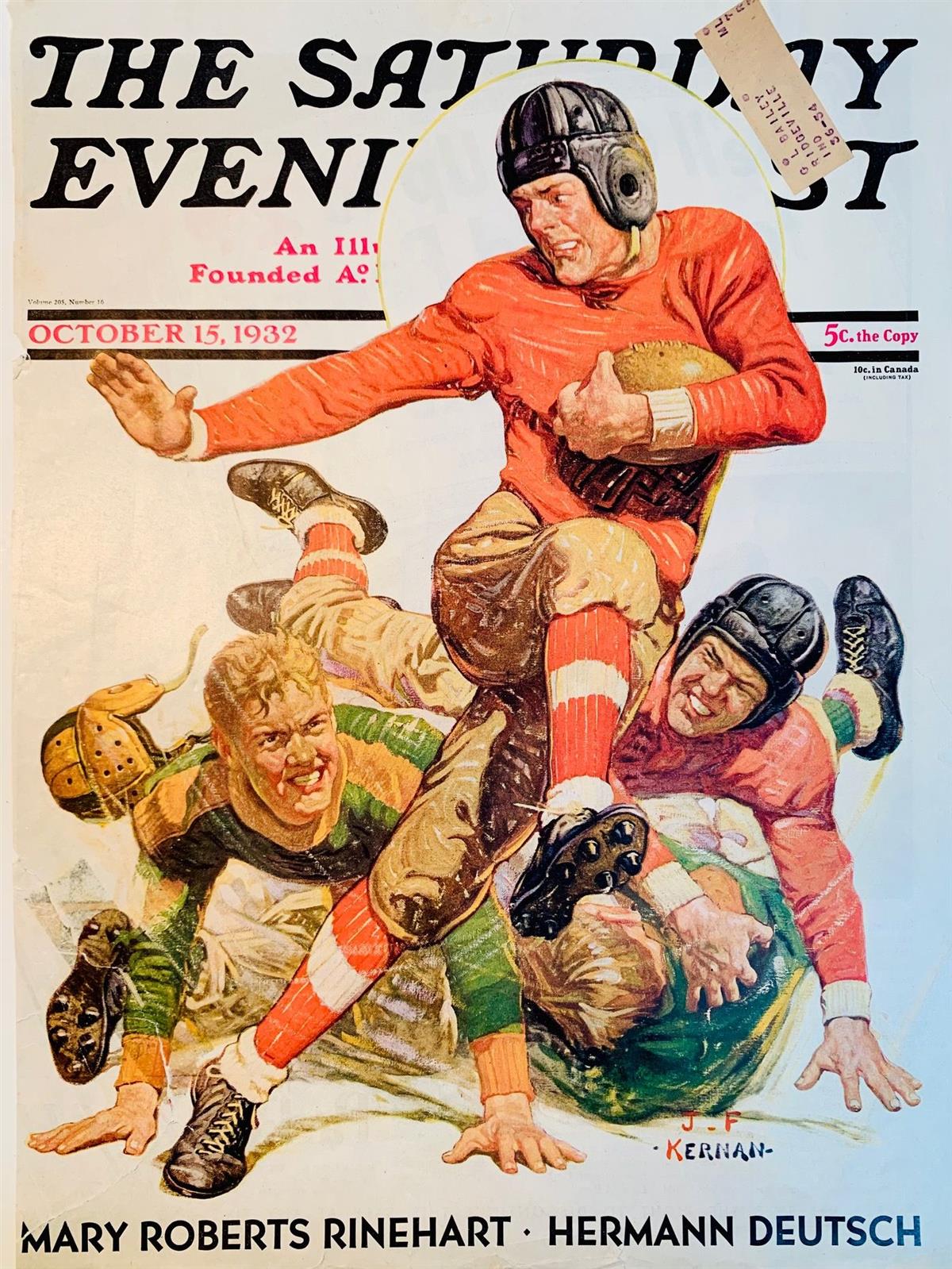
In his heyday between the two World Wars, Joseph Francis Kernan (1878-1958) made art that glowed from the covers and pages of virtually every popular American publication, not to mention hundreds of advertisements, calendars and other promotions.  His 1932 oil on canvas, College Football, painted for the cover of the Saturday Evening Post that same year, is considered by some to be the inspiration behind the most iconic trophy in college sports, the Heisman, sculpted by Frank Eliscu two years later. 

 In 2021, the original painting entitled College Football along with a tear sheet from The Post's cover, would fall under the auctioneer's hammer at $75,000. 


Less than a year later, another oil painting made for a Saturday Evening Post cover entitled "Tying On A Fly" would be auctioned from a private collection at $126,000.   Despite industry insiders slapping him with the damned-with-faint-praise nickname, "the poor man's Norman Rockwell,"  owning an original piece of J.F. Kernan's art has become anything but a poor man's game.


Born in Brookline, Massachusetts, J.F. Kernan reportedly was an uncommon team sports athlete who loved the outdoors.  He paid his art school tuition by playing professional baseball, stayed on at Boston's Pape School of Art for two years, teaching, then headed for New York City to further his illustrator's career. 

                              ***(see at bottom)


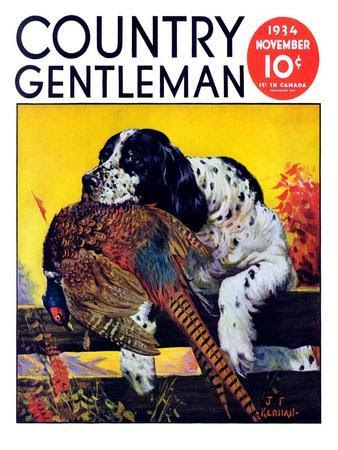
One quotation comes up again and again in online research on Kernan, his explanation for his particular story-telling angle.  Kernan said his beat was "the human side of outdoor sports, hunting, fishing, and dogs."   Happily for me, when Kernan painted a dog, that dog was most likely to be an English setter.


Critics tout Kernan's sense of humor in his work.  He wasn't above playing to convention, the standard gag featured on the covers of sporting magazines everywhere being the hunter surprised by his quarry.


Kernan was the pro's pro of commercial illustrators, forever playing to the crowd.  In selling magazines, beer, tires, or calendar art (like the first one below, published by the venerable Goes Lithographing Company, and entitled "Seven New Playmates"), what could have broader appeal than a litter of English setter puppies?


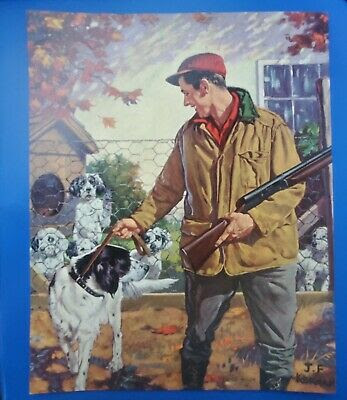
A recurring motif in Kernan's puppy portraits can be seen in the second Saturday Evening Post cover of this blog post, as one or more of the parents is lead away from the litter, supposedly headed for a day afield.


In Kernan's world (and mine), all English setter breeders worth painting are hunters.  They enjoy spending time with the litter, constantly weighing merits of the youngsters against the day when Pup goes into the game fields and shows that she's a chip off the ol' block...and a natural for hawking Grain Belt beer!


There may not be a hoarier upland cliche than The Dilemma of the Posted Covert, a quandary for Dog and Gun that Kernan believes can sometimes be solved with a good will offering.


The proferred cigar painting above became a cover for Capper's Farmer which, since 1893, has been printing "Practical Advice For The Homemade Life" in Canada and the US. Capper's Farmer is still in publication (https://www.cappersfarmer.com/ ).


Certainly one of the hallmarks of Kernan's portrayal of English setters is his depiction of them in our lives, and not just during hunting season.  For example, those who may occasionally or even habitually commit fishing, will appreciate the English setter visualizing a smokey streamside brag about "the big one that got away."


Maybe more than anything, though, what makes Kernan's work endearing to a gun dog aficionado is the affection apparent in each scene.  His men (and I could find no women painted into Kernan's upland world) love their dogs, and vice versa.


Kernan's portfolio includes several stock examples of the "lacing up the boots in front of the psyched and pleading gun dog" genre.  This was the only one that depicted a pointer.  Because it is of the old style, heavily marked, head-full-of-brains-not-wind pointer, I felt deputized to sneak it into a setter blog.


Part of the humor in Kernan's illustrations rests in the dogs' expressions.  In this Outdoor Life cover, the "Now what?" look on that setter's face says it all.


My favorite model for Kernan is the white mustachioed, dapper fellow who appears in numerous paintings.  I've dubbed him "The Gent," and he exudes everything that is my imaginary New England grouse gunner from another time,  a guy who could've been a charter member of Corey Ford's Lower Forty Hunting, Shooting, and Inside Straight Club.  

The Gent is dapper in his double-knotted Bean boots, battered fedora, and the necktie he always wore into his coverts.  I suspect his hunting coat reeks of pipe tobacco, his breath tart from the nip of hard cider taken for medicinal purposes back at his shooting brake, his team of horses drowsing in the October sun, the leg o' mutton case for his Ithaca or Parker double tucked under the buggy seat.

He's an easy character for my own made-up tales around Kernan's art.  The painting below is my current favorite.  


Maybe that's his grandson, home on leave from the service.  The young man has killed a ruffed grouse over The Gent's setter; as the old man admires the bird, he's thinking of other grouse on other days when he was the young man, palming a soft-mouthed retrieve from the grand sire of the dog hunting with them here.  

He handles that bird, admires that bird, in a way that says every ruffed grouse in hand is a wonder, a great good gift that, for him, can come only one way - from his coverts,  his worn double shotgun, and an English setter bred to work and look and behave just so.

Sure it's maudlin.  But that's the popular illustrator's hole card, to depict us they way we fancy ourselves, the way we wish we were.  I am far closer to the Gent than to the ramrod-straight, ruddy faced younger fellow and maybe that's the bottom line of my love of Kernan's art:  a yearning for a simpler time of sportsmanlike mores, of grouse and woodcock-rich coverts bare of bootprints and carelessly discarded shell casings, of fast, keen, feather-tailed English setters working for the Gun without bells, beepers or Elon Muskian GPS antennae.  

More than anything else, Kernan's art speaks to me in its depiction of devotion to and from the dog.  The fact that he painted setters reminiscent of the Firelight dogs I love most only seals the deal.  I may never be more than a Gent wannabe, but, like my imagined version of him,  I by gadfrey know what I like.


*** I so badly wanted the Corey Ford piece touted on Kernan's baseball player magazine cover to be an upland hunting story.  Instead it was a long piece of sappy (even for Corey) romantic fiction.  Sigh.  More promising was an article entitled "Dogs In A Big Way," featuring a full page head study of two English setters by the ubiquitous Lynn Bogue Hunt.  Sadly, the article was about a wire-haired terrier fancier's trials and tribulations in the show ring, grooming shed, and in a trans-Atlantic search for a suitable replacement for the animal repeatedly referred to as "the dog Dick."   Arg.  

Anyway, here's the full page Hunt painting from The Saturday Evening Post, 5/28/1932.  I had never seen it before researching this blog: 


Wednesday, April 20, 2022

No Longer Kennel Pent


By Randy Lawrence


 I have four chain link kennels at the farm, the old Mason kind dating back to the 1970's.  I have exercise yards, too.  "Thunderdome" encircles the kennel building and runs; "Beyond Thunderdome" encloses my back yard off the utility room door.  

When I cannot be with my dogs or cannot take them with me safely, they spend time there.  When I am home, they are with me, either "free-ranging" or crated on the (extremely) rare occasion we have dog-nervous guests or tradespeople forever helping me cobble together this old farmhouse.  That's how we roll.

The kennels on the hill were built by the former owner of this property.  Bob generally had but one dog in the house at a time in the years that he was hunting four or five.  He liked the focused one on one time, and each dog took a turn, day and night.  But each dog had a kennel as well.  

When the topic was broached, my friend would sternly say, "This is my house.  My dogs visit.  That is their house.  I visit them there."  That was the sense of order he believed in, and his setters, pointers, and Labradors were happy, well-adjusted, mannerly hunting, house, travel, and kennel dogs.  No destruction or riotous nonsense in the house, no manic, nuisance barking in the kennels, calm and relaxed in the crates when we traveled.

As he got older and his crew slipped to fewer and fewer members, kennel time dwindled as well, until toward the end, the one or two dogs who shared his life spent not a minute in their assigned kennel runs.  When his full-time shadow, a pointer named Cotton, became very ill, Bob was, too, and I handled that awful final vet visit.  When I returned to the farm, Bob was rocking in his chair by the window.  I sat in the black captain's chair nearby, both of us monstrously aware of the empty dog bed on the floor between us.

Without looking at me, he said, "Tonight will be the first time I will sleep in a house without a dog since I came home from the war."  That was WWII...69 years before.

Within a week, he was asking me to research Labrador retrievers from imported British lines.  After poring over pictures and pedigrees and long phone calls with breeders, I was dispatched to eastern Nebraska with an envelope full of cash.  I made a rump-numbing, round-trip swing with pauses only for gas on the way out, puppy clean-out stops on the way back. That's how Quail Valley Boots Randolph came home to Ohio, the light of the last four years of Bob's life.  Boots never saw the inside of his kennel while Bob was here.


A long time ago, an inveterate dog jockey of my acquaintance brought an English setter to me, asking for help.  The guy was kind of a lurker on the fringes of the best grouse dog kennels in Michigan and a tony gun club in central Ohio, scooping up dogs that were free or available at a bargain rate because of some issue or another.  When he brought Ghillie, his assessment of the anxious little white dog with a tan ear was, "He was simply too long in kennel pent."  He left him as a boarder, promising to pay for his care and some basic training...and called a month later pleading poverty and trouble at home.

So Ghillie stayed.  The man was right.  Once he realized that time behind chain length was but a siesta, not a sentence, he relaxed, signed on to our team, and began flashing what his heavy-hitter pedigree said he was - a hard-going, biddable grouse hunting partner.  

I have only two pieces of taxidermy from forty years of bird hunting. One is an Ohio grouse taken off a rocky strip mine contour, pinned for a very long time by a little white dog with one tan ear.

The bird dogs at Lynn Dee's home meld into a seamless routine of living that is a mix of dog bed, human bed, comfy couch, and occasional crate or kennel.  In the coming weeks, Lynn Dee's pack will assimilate the newest family member, the swaggering spark plug of a puppy Pocket, kept from Dreamboat Annie's second litter.  


Storm and Sally will insist Pocket minds her p's and q's, Flint and Kate will pretend she's not there, Seth will think she's interesting and want to play, and Annie will be glad she's not solely her responsibility any more.

But find her place, she will.  After all, Firelights are bred for the fireside, marking time between autumn woods and fields.